








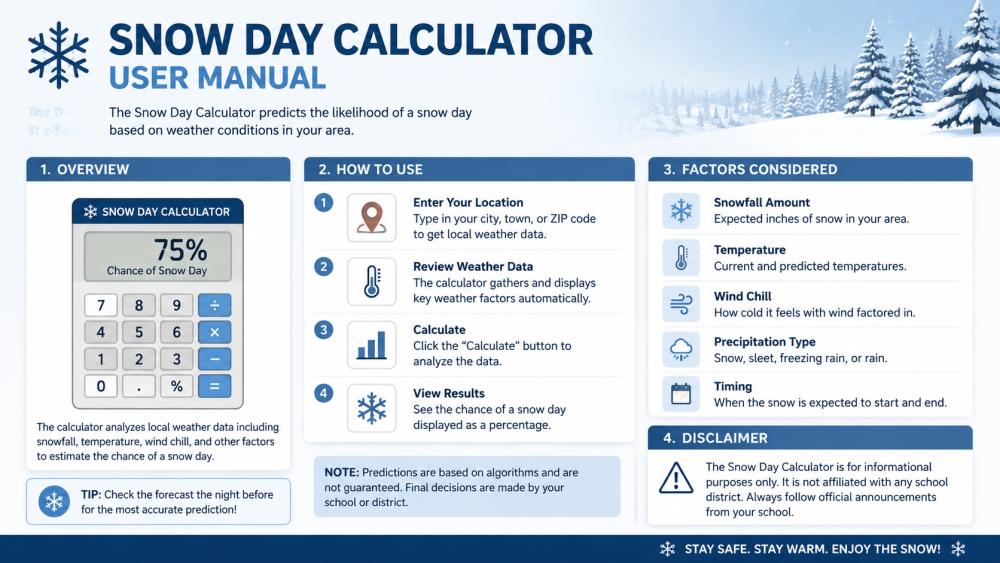
Snow Day Calculator Manual: Predict School Closings in 2026

Introduction
It is 10 PM. A storm is rolling in. Your kids are already plotting their morning of sledding, and you are glued to weather apps refreshing every five minutes. Sound familiar?
Here is the frustrating truth: most people have no idea how snow day predictions actually work. They trust a single weather app, cross their fingers, and hope for the best. But what if you could understand the exact formula that determines whether school gets canceled tomorrow?
That is exactly what this guide covers. The snow day calculator manual method is your behind-the-scenes look at how these predictions are made, so you are never caught off guard again. Whether you are a parent, student, teacher, or school administrator, this 2026-updated guide gives you actionable intelligence that most articles skip entirely.
What Is a Snow Day Calculator Manual Method?
The "manual" version of a snow day calculator refers to the original user-driven input model that powered the very first generation of school closure prediction tools. Before automatic data retrieval existed, users had to personally look up weather information and enter it into a prediction system themselves.
The Snow Day Calculator was originally started as a middle school side project in 2007 to predict the chance of school closings, where users entered weather information they had to look up themselves and the tool outputted a likelihood for the next day.
Understanding this manual process does something critically important: it shows you exactly which variables matter most in any prediction, automated or not. If you know the inputs, you can read any forecast with sharper eyes.
The 5 Core Variables in Every Manual Snow Day Prediction:
- Snowfall amount (total expected accumulation in inches or cm)
- Storm timing (overnight vs. morning snow dramatically changes outcomes)
- Temperature and wind chill (sub-freezing temps amplify closure risk)
- Ice and freezing rain probability (often more dangerous than snow itself)
- Historical school district behavior (some districts close at 2 inches; others need 10)
How to Use the Snow Day Calculator Manual Formula (Step-by-Step)
You do not need an app to run a rough snow day probability calculation. Here is the framework experts and school administrators actually use.
Step 1: Check Total Snowfall Forecast
Open a trusted meteorological source like the National Weather Service (weather.gov) or NOAA. Look for the 24-hour snowfall total for your exact ZIP code.
Generally, 5 to 6 inches of snow is enough to cancel school in many areas, but that threshold shifts dramatically by region. A few flurries might shut down schools in Texas, while Minnesota may need a full blizzard.
Regional Snow Thresholds (2026 Reference Guide):
| Region | Typical Closure Threshold |
|---|---|
| Southern US (TX, GA, SC) | 1 to 2 inches |
| Mid-Atlantic (VA, MD, DC) | 3 to 5 inches |
| Northeast (NY, MA, PA) | 5 to 8 inches |
| Midwest (OH, MI, IL) | 6 to 10 inches |
| Great Lakes (lake-effect zones) | 8 to 12+ inches |
| Canada (Ontario, Quebec) | 15 to 25 cm |
Step 2: Evaluate Storm Timing
Storm timing is the single most underrated variable in manual snow day predictions.
- Snow falling between midnight and 6 AM = highest closure probability. Roads and school buses cannot be cleared in time.
- Snow falling 6 AM to 9 AM = moderate to high probability. Administrators make calls early, often erring on caution.
- Snow falling after 10 AM = lower probability. Schools may open normally even with heavy afternoon accumulation.
Pro Tip: A 3-inch overnight storm often beats a 6-inch afternoon storm for generating a snow day. Timing is everything.
Step 3: Factor in Temperature and Wind Chill
Even when temperatures are above 32 degrees Fahrenheit, a strong wind can make the day feel cold enough to warrant a snow day, particularly when wind chill threatens student safety at bus stops.
If the wind chill is projected below 0°F (minus 18°C), many northern districts will call a cold day closure even without significant snowfall.
Step 4: Assess Ice and Road Conditions
This is the variable most snow day calculator guides miss entirely.
More than 60% of school closure decisions are actually based on road conditions and bus safety, not just snow depth.
Light snow followed by freezing rain is often worse than a heavy snowstorm because it creates slick, dangerous ice. Icy roads might be the reason schools are closing even when snow totals are low.
Manual Ice Risk Checklist:
- Is freezing rain or sleet in the forecast?
- Will temperatures dip below freezing overnight after rain?
- Are secondary roads and rural routes in your district prone to black ice?
If you answer yes to any of these, add 15 to 20 percentage points to your estimated snow day probability.
Step 5: Apply Your District's Historical Pattern
No algorithm replaces knowing your own school district. Over three to five winters, track:
- The minimum snowfall amount that triggered past closures
- Whether your district tends to call closings the night before or morning of
- How often they choose delayed openings vs. full cancellations
Accuracy drops significantly in regions where school policies are unpredictable or highly variable, making local historical data one of the most valuable inputs in any prediction model.
The Snow Day Probability Scoring Framework (Original Model)
Here is an exclusive framework you will not find on competing sites. Use it to calculate a rough snow day percentage on your own:
Base Score Calculation:
- Start at 0%
- Add 20% per inch of forecasted snowfall (cap at 60%)
- Add 15% if the storm peaks between midnight and 7 AM
- Add 10% if wind chill drops below 10°F (minus 12°C)
- Add 20% if freezing rain or ice is in the forecast
- Adjust plus or minus 15% based on your district's historical strictness
Example: A storm forecasting 4 inches overnight with wind chills of 5°F and no ice:
- 4 inches x 20% = 80% (capped at 60%)
- Overnight timing: +15%
- Wind chill: +10%
- Total: 85% snow day probability
"The most dangerous assumption in snow day prediction is treating snowfall as the only variable. Districts close schools to protect children, not to respond to snowflakes — and that means road safety, bus routing, and wind chill are equally critical inputs."
Manual vs. Automated Snow Day Calculators: Which Is More Accurate?
While traditional snow day manual checks rely on watching weather reports or calling schools, AI-driven tools automate predictions. Modern snow day calculator 2026 editions use real-time satellite imagery, IoT sensors, and machine learning models to refine results.
Short-term predictions within 24 to 48 hours achieve 80 to 92% accuracy for major snow events of 4 or more inches. Medium-term predictions covering 3 to 4 days drop to 65 to 75% accuracy, while long-range forecasts of 5 to 7 days hover around 50 to 60%, barely better than a coin flip.
When manual checking outperforms automated tools:
- You know your district's superintendent personally or follow their social channels
- Your area has a microclimate that general ZIP-code tools miss
- A storm is tracking unusually close to your area's edge (a 20-mile shift in storm track changes everything)
- Local road conditions (a steep hill, a rural route) are factors no algorithm models
Expert Tips to Maximize Your Snow Day Prediction Accuracy
Tip 1: Watch the National Weather Service, Not Just Apps Consumer weather apps smooth out data to avoid alarming users. The NWS (weather.gov) gives you raw probabilistic forecasts, hourly breakdowns, and winter weather advisories that are far more granular.
Tip 2: Follow Your Superintendent on Social Media Many school leaders now post closure decisions on X (formerly Twitter) or Facebook before the official robocall goes out. A simple follow can give you a 30-minute head start.
Tip 3: Use Multiple Tools and Average the Results The most accurate calculators pull from multiple authoritative sources including NOAA, the National Weather Service, and regional weather stations, cross-referencing predictions rather than relying on a single data feed.
Run your zip code through two or three calculators and take the average probability. If all of them show 70%+, your confidence level should be high.
Tip 4: Track Decisions in a Simple Spreadsheet Log each winter storm with: date, total snowfall, storm timing, temperature, and whether school was canceled or delayed. After two seasons, you will have a hyper-personalized prediction model for your specific district.
Tip 5: Never Bet on a 50 to 65% Prediction This is the gray zone where everything depends on last-minute administrator judgment. Keep plans flexible until you hit 70%+ or receive an official notice.
Why Snow Day Predictions Are Getting Harder in 2026
Climate patterns are making winter weather increasingly unpredictable. Warmer baseline temperatures mean more rain-to-snow transitions, which produce the most dangerous and least forecastable conditions. Lake-effect snow bands are intensifying in Great Lakes regions while Southern states experience rarer but more disruptive winter events.
Additionally, many districts are now weighing remote learning options against full closures, adding a new variable to the equation that no traditional calculator accounts for.
Some schools now want to swap snow days for remote learning days, a trend that fundamentally changes how closure decisions are made and what "snow day" actually means in a prediction context.
Key Takeaways
- The snow day calculator manual method uses five core inputs: snowfall amount, storm timing, temperature, ice risk, and district history.
- Storm timing often matters more than snowfall total. A 3-inch overnight storm beats a 6-inch afternoon storm for school closings.
- More than 60% of closure decisions are driven by road safety, not snow depth alone.
- Short-term predictions (24 to 48 hours) are 80 to 92% reliable. Long-range forecasts are barely better than guesswork.
- Build your own district-specific model over two to three winters for the sharpest predictions.
- The rise of remote learning days in 2026 is reshaping how closure decisions are made.
Conclusion
Understanding the snow day calculator manual method is not just nostalgic trivia. It is a practical framework that makes you a smarter reader of any automated tool, weather app, or school notification. When you know what variables matter, you stop panicking at every weather alert and start making confident, data-driven plans.
The best snow day prediction is not one that comes from a single app. It comes from combining real meteorological data, local district knowledge, and the simple formula that has driven accurate predictions since 2007. Use this guide as your go-to resource every winter season, and share it with other parents, teachers, and students who deserve better than guessing.


