








The Hidden Cost of Manual Audit Processes

An audit may look straightforward from the outside. An auditor defines the scope, requests evidence, reviews documents, records findings, and prepares a report.
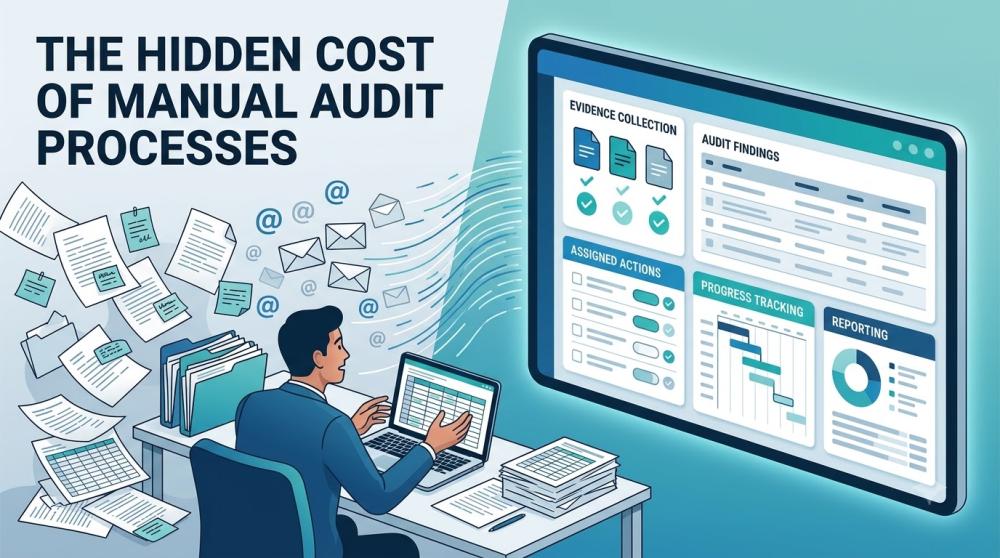
In practice, the process can involve hundreds of emails, spreadsheets, shared folders, meetings, reminders, and document versions.
For organisations managing multiple audits at the same time, these manual activities can become a significant operational burden.
The problem is not simply that manual processes take longer. They can also make it harder to maintain consistency, track responsibilities, and understand what is happening across different audit engagements.
Where Do Manual Audit Processes Start to Break Down?
Evidence collection is one of the most common pressure points.
An auditor may request several documents from different teams. Each team responds at a different time, sends files through different channels, or provides incomplete information. The auditor then has to follow up, organize the documents, and determine which version is current.
The same process may happen repeatedly across multiple audits.
Over time, teams spend considerable effort managing information rather than evaluating it.
This can also create visibility problems. A manager may know that an evidence request is outstanding but have little insight into how it affects the overall audit timeline.
Why Does Evidence Management Matter?
Audit evidence needs to be reliable, relevant, and traceable.
If documents are stored across shared drives, inboxes, and local folders, finding the correct evidence can become difficult. Older versions may remain accessible, while newer documents are buried in email conversations.
A centralized process can make this easier by connecting evidence with the relevant audit, control, finding, or assessment.
Modern audit platforms increasingly focus on structured audit evidence collection and workflow management so teams can track requests, responses, supporting documents, and outstanding items in one place.
This is particularly useful when several stakeholders are involved in the same audit.
What Happens When Audit Actions Are Not Clearly Assigned?
Findings are only useful when somebody acts on them.
Without clear ownership, corrective actions can sit unresolved after an audit report has been issued. Teams may assume another department is responsible, or an action may simply disappear among other operational priorities.
Clear ownership helps solve this problem.
Each action should have an identifiable owner, a reasonable deadline, and a way to demonstrate completion. Escalation can also be useful when important actions remain overdue.
This creates accountability without requiring managers to manually chase every task.
How Can Automation Reduce Audit Delays?
Automation can remove many repetitive administrative steps from an audit.
For example, automated reminders can notify stakeholders when evidence is due. Task routing can direct findings to the appropriate owner. Predefined workflows can guide auditors through consistent review procedures.
These functions do not replace professional judgment. Instead, they reduce the amount of routine coordination required to keep an audit moving.
That gives auditors more time to focus on analysing evidence, identifying patterns, and assessing whether controls are actually working.
The International Organisation for Standardisation provides standards and guidance used by organisations to structure management systems and evaluate conformity, making consistent processes and documented evidence important considerations for many audit environments.
Why Does Real-Time Reporting Matter?
Traditional audit reporting often happens at the end of an engagement. By then, management may have limited visibility into what caused delays, which findings are most significant, or how many corrective actions remain outstanding.
Real-time reporting changes the conversation.
A dashboard can show audit progress, overdue evidence, open findings, action closure rates, and upcoming reviews. Leadership can then identify bottlenecks before they affect the final outcome.
This is especially useful for organisations running multiple audits across different departments or locations.
Instead of asking teams for individual status updates, decision-makers can work from a shared view of current information.
Does Automation Mean Losing Human Oversight?
No. Auditing still requires professional judgment, context, and critical thinking. Software cannot decide whether a control is appropriate for a particular business situation or whether evidence provides sufficient assurance.
The purpose of automation is to support that judgment.
By handling repetitive activities such as reminders, task assignment, document organisation, and status tracking, technology allows audit professionals to spend more time on analysis.
The result can be a more efficient process without turning auditing into a purely automated exercise.
What Should Organisations Improve First?
Organisations do not need to automate every part of auditing at once.
A practical starting point is to identify the most time-consuming manual activities. If teams spend hours chasing evidence, start there. If corrective actions frequently become overdue, improve task tracking. If leadership struggles to understand audit status, improve reporting and dashboards.
Small improvements can create meaningful gains when they address genuine bottlenecks. The wider objective is to create an audit process that is organised, traceable, and easier for everyone involved to manage. AssurePlus help enterprise organisations solve audit management and compliance audit management through its AI-integrated GRC platform.
Conclusion
Manual audit processes can create costs that are easy to overlook because they are spread across many small activities.
Time spent searching for documents, chasing evidence, reconciling spreadsheets, sending reminders, and preparing reports can quickly add up. More importantly, fragmented processes can make it harder to maintain a clear view of audit progress and unresolved issues.
Improving the audit workflow does not mean removing human judgment. It means removing unnecessary administrative friction so auditors and business teams can concentrate on the work that creates the most value.
A more structured and connected approach can make audits easier to manage, improve accountability, and turn audit information into something leadership can use rather than simply file away.


